As of this writing (mid-2026), FC Venus is still an unrealized dream. Our first FreeCalypso development board, i.e., FCDEV3B, quite successfully replicates TI Leonardo in sans-UI configuration, i.e., intermediate Leonardo versions from the end of 2003 (see the linked page) without functional D-Sample-like LCD and keypad peripherals, capable of running TCS211 firmware only in modem configuration with phone UI layers excluded, controlled via AT commands. What we still lack is a platform like the original D-Sample or its apparent successor Leonardo Sample, featuring not only the absolutely required core chipset, but also the particular set of peripherals (originating from D-Sample) needed in order to run TCS211 firmware in its full glory, including the UI-enabled handset configuration that runs untethered.
The following peripherals are required in order to run UI-enabled configurations of TCS211 firmware and exercise all of its functions:
This large size (very large compared to all known mass-produced phones with TI Calypso chipset) is required in order to run TCS211 phone UI layers, no reduced size will do. The native 16-bit parallel interface, exactly like on the original D-Sample, is also required because alternative interface options (serial or even 8-bit parallel) would be too slow for this large screen size on our plain old Calypso. (The update time goes up with the display size in pixels, and regular Calypso, unlike Calypso+ or LoCosto, has no DMA hardware to which this task can be off-loaded.)
This D-Sample keypad button set consists of 21 buttons in the main keypad area (with the red button being PWON outside of KBR/KBC matrix) plus 3 side buttons. (Incidentally, it is the same keypad arrangement as on Pirelli DP-L10, except for Pirelli having moved the right side button to the left side and made it into their camera button.) Earlier Leonardo boards that weren't Leonardo Sample won't fit the bill with their 18-button keypads, but on any newly designed board we can trivially implement a keypad of the correct configuration.
Classic TCS211 firmware uses this buzzer to play the ringing tone on incoming calls, as well as some other tones. This buzzer exists on D-Sample, placed right on the main board (not in the attached handset part); we don't know if TI also replicated it on their mystery Leonardo Sample board, but the firmware expects it.
The same buzzer also exists on Motorola C11x/12x and C139/140 phones. In FreeCalypso we successfully extracted high-quality ringtone melodies (played via the buzzer in PWT mode) from a Mot C11x firmware version, and we intend to preserve buzzer ringing support from TCS211, to be modified to use PWT mode with downloadable melodies in FFS.
Fortunately the 176x220 pixel LCD size which we need is one of
industry standard sizes, and finding new LCD modules of this size
with the required 16-bit parallel microprocessor bus interface
was not too difficult.
Instead the real difficulty was in finding a Calypso+Iota+Rita platform
(as opposed to Clara RF for which we lack tpudrv10.c)
where we can access the Calypso memory bus for the purpose of
connecting such LCD: most packaged modem modules don't bring it out!
But then in the waning days of 2019 we discovered
iWOW TR-800 modules, and in early 2020
FreeCalypso core team managed to score two iWOW DSK (Developer Starter Kit)
boards that bring most module signals, including the memory bus
and the keypad interface, to an expansion interface header.
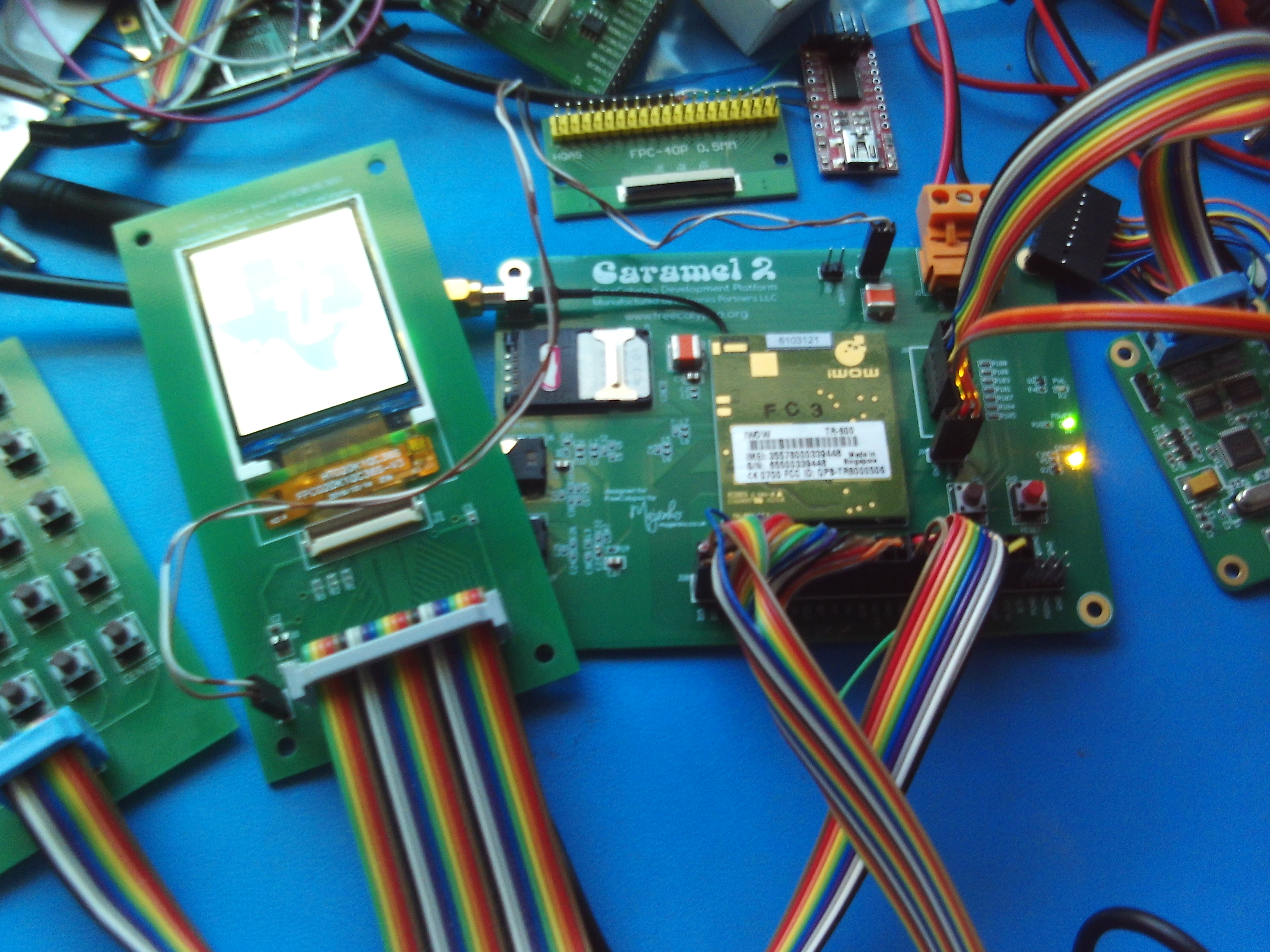
The original iWOW DSK board was codenamed Caramel, while the configuration with our own 176x220 pixel LCD connected to Calypso MEMIF was named FreeCalypso Luna. The physical arrangement was a royal mess, with a Caramel-type motherboard (either the original DSK or our own Caramel2), the LCD board, the keypad board and DUART28 interconnected with ribbon cables, but it was the first time in our project history when we finally got firmware with phone UI layers included (TCS211 with minimal modifications at first, then bolder changes of our own) running on a functional Calypso GSM MS with a directly connected LCD, as opposed to our previous hacks of retrieving the firmware's display framebuffer content over a slow UART interface.
This FC Luna platform served us well until the summer of 2021, at which point we ran into some major limitations:
Calypso BU/PWT signal is not brought out on FC Tango
(formerly iWOW TR-800).
This omission is a problem for us, as it results in us lacking
a single platform that has both the large 176x220 pixel LCD
and the classic Calypso buzzer.
(The original D-Sample has both, but we lack tpudrv10.c code
for it.)
We desire a development board that has all 3 audio routing options:
the default handheld
mode, even if it is emulated via an FC-HDS4
headset, hands-free loudspeaker (8 ohm speaker output like on FCDEV3B)
and the official
headset audio channel on Iota ABB.
Out of these options, the last one is not brought out on iWOW TR-800
turned FC Tango.
As part of preliminary design work toward a far-future FreeCalypso end user handset, we came up with a very slick way of driving the backlight LEDs in our fancy LCD, using MAX1916 constant current sink. We also came up with a very slick way of producing different backlight intensity levels by switching MAX1916 LED current via two additional GPIO outputs from Calypso. We would like to have this hw feature working on our main fw development platform, but it is not implemented on Luna.
Following the feminine-celestial naming scheme of Themyscira,
the next UI-enabled GSM MS development platform after FC Luna shall be
FC Venus.
This board will need to be built the hard
way, directly from chips
just like FCDEV3B, as opposed to using a Tango (or heaven forbid, GTM900)
packaged modem module.
The fundamental reasons for unsuitability of Tango are listed above —
lack of Calypso BU/PWT and Iota headset channel bring-out — and once
we have committed to doing it the hard
way, we are going to bring out
or otherwise make use of a few other Calypso+Iota chipset signals that are
in the same situation.
FC Venus will be a development board in a generally unconstrained, simple rectangular form factor. Our vision is that it will combine all of the following major hardware blocks on this single board:
Calypso+Iota+Rita GSM MS core, same as FCDEV3B or Tango. Our current plan is to make it quadband like Tango, but keep the larger flash+RAM chip from FCDEV3B.
Same power input connector as on FCDEV3B and Caramel2 (and previously on C-Sample, D-Sample and Leonardo), allowing operation either with a fixed power supply or an actual battery for true mobility.
LCD and keypad buttons, placed so that the board will be usable as a handset prototype.
Full assortment of audio options:
handheldaudio channel and the
officialheadset channel.
A USB subsystem directly on the Venus board itself, equivalent to a built-in DUART28, connected to both Calypso UARTs.
A battery charging circuit of the most classic type,
controlled by Calypso+Iota chipset, controlling the flow of charging power
from USB to the battery connector.
However, USB VBUS will pass through a manually operated slide switch
before being treated as VCHG, to avoid repeating the mistake of
Pirelli DP-L10 where it is impossible to establish computer communication
with the Calypso target without presenting charger plug
condition
to Iota VRPC.
Headers for the dual UART and boot control interfaces that exist between the mobile and USB domains — see below.
Additional headers that bring out Calypso JTAG and MCSI, as well as some interfaces between DBB and ABB which we could never tap before.
We further envision that some of these components may be optionally populated, allowing the same PCB to support multiple configurations:
The on-board USB subsystem can be omitted, instead allowing external connection to Calypso UARTs and boot control signals. It won't make any sense to omit on-board USB only to connect an external DUART28 adapter that does the same thing, but the UART interfaces on our existing FCDEV3B and Caramel2 boards can be connected to more than just a USB-serial adapter, and the same ability should be preserved on FC Venus.
The LCD and keypad buttons can likewise be omitted, producing a quadband successor to FCDEV3B for the purpose of running modem fw configurations controlled via AT commands.
With the LCD and keypad subsystem either omitted or simply left unused when a sans-UI modem fw configuration is loaded, and with the on-board DUART28 equivalent being optional at board population time, FC Venus should almost fully supercede FCDEV3B, i.e., it should be suitable for almost every application where FCDEV3B is called for otherwise.
This part is where some disappointment is called for: while this FC Venus board is very highly desired on our part, our current plan is that we won't resume working on it until after American 2G Cooperative achieves some success — probably another few years out.