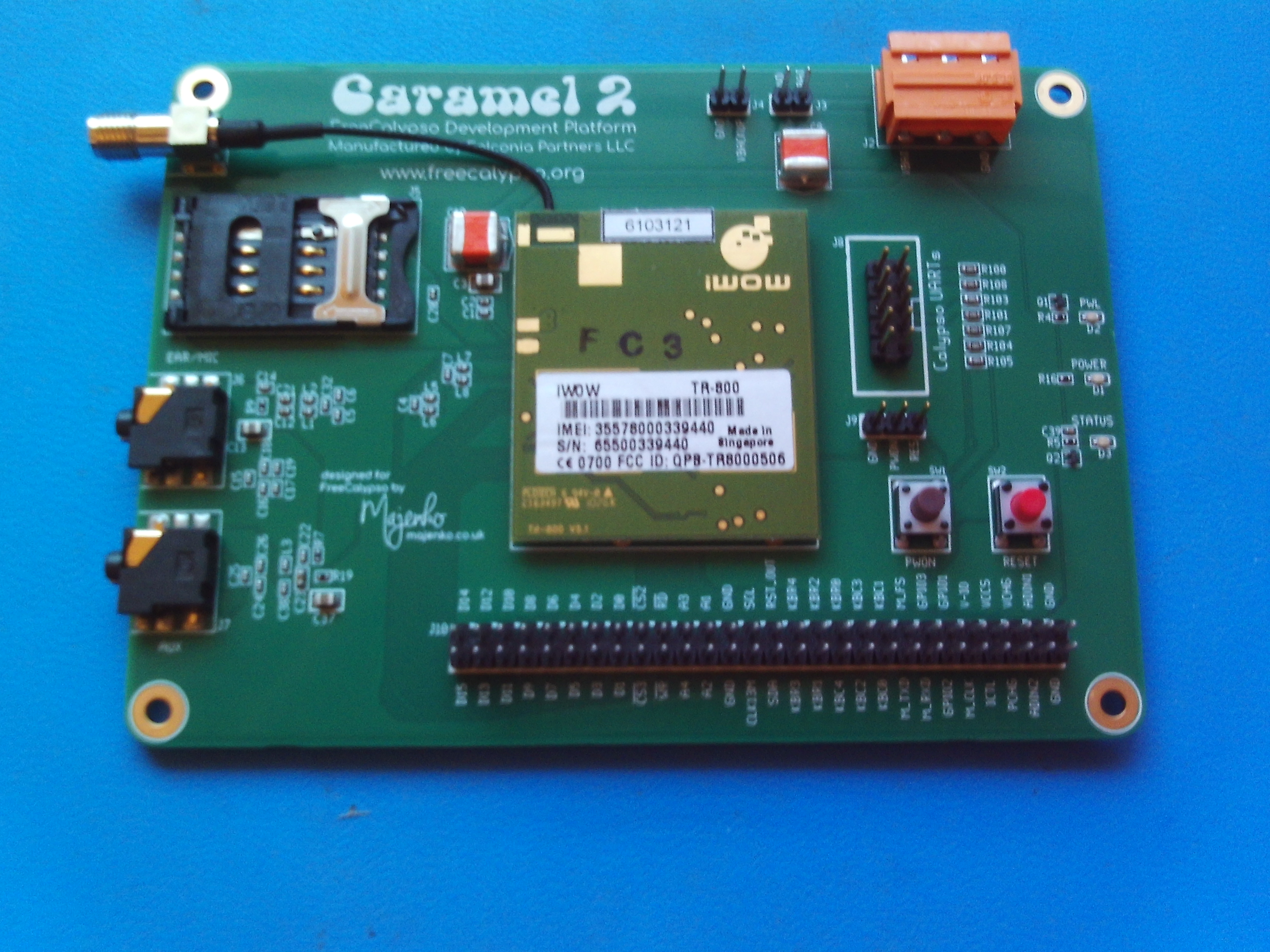
FreeCalypso Caramel2 is a development board built around our Tango core module. These boards were produced in year 2020 for reasons that made sense then, but which are irrelevant in the present time (2026). The present situation is that these C2 boards are a cheaper alternative to FCDEV3B: the quality is not as good, but we have more of them in stock and can therefore let go of them for a lower price.
iWOW Connections Pte Ltd, the company that originally made TR-800 modules that are now FC Tango, had a development board for them which they called DSK: Developer Starter Kit. Within FreeCalypso core team this iWOW DSK board (the original one, not made by us) was codenamed Caramel. But we only had two of those original DSK or Caramel boards, while desiring to make our Tango modules available to a larger audience. We decided to design and produce our own Tango-based devboard, and because this design was a sort of increment upon the original Caramel, we named our version Caramel2.
We have the following documentation for Caramel2:
The following aspects are exactly the same between FCDEV3B and Caramel2 devboards:
Both boards run the same selection of FreeCalypso modem firmwares, with all of the developer empowerment they provide — just make sure to select the correct compilation target, as the binaries are different as necessitated by some small hardware differences.
Both boards bring out two Calypso UARTs and MCSI, the auxiliary interface to the DSP part of Calypso.
Both boards require the same type of power supply, either battery-emulating power (3.6 V nominal) or an actual battery.
The following aspects are better on FCDEV3B:
Flash capacity: 16 MiB on FCDEV3B, 8 MiB in the Tango module on Caramel2.
RAM capacity: 512 KiB of fast IRAM and 8 MiB of slower XRAM on FCDEV3B, 256 KiB of fast IRAM and 2 MiB of slower XRAM in the Tango module on Caramel2.
Practical effect of large XRAM on FCDEV3B: one can run a full GSM MS firmware image in RAM without flashing; the same feat is not possible on Tango platforms.
FCDEV3B has JTAG, Tango does not.
Analog audio on Caramel2 turned out poorly, GSM Tx buzz gets mixed into both earpiece and microphone paths. Yet on FCDEV3B analog audio is perfectly clean during voice calls.
Indicator LEDs on Caramel2 sometimes exhibit erratic behavior, as detailed in the Status Report and User's Guide linked above. No such problems ever occur on FCDEV3B.
On the other hand, Tango modules and Caramel2 boards built around them offer the following advantages:
FCDEV3B is triband, there is no possibility of supporting both 900 MHz and 850 MHz bands on the same board. OTOH, FC Tango is fully quadband.
Many more Calypso+Iota chipset signals are brought out, even the main microprocessor bus. If you wish to connect extra peripherals to your Calypso-controlled system, Tango is the only way to do it.
Because some important aspect of Caramel2 design turned out poorly, we don't plan on making any more of these boards once we clear our existing stock. Going forward our main focus will be on FC Venus, and we may also produce a new batch of FCDEV3B, if our original flagship board remains popular.
However, if someone in the community strongly desires to play with additional Calypso and Iota interfaces that are only available by way of Tango modules, or desires a proper evaluation and prototyping board for these modules for any other reason, we will need to produce a more proper, higher-quality successor to Caramel2. Following TI's original naming convention for evaluation boards, this hypothetical board may be named EvaTango — but we will activate this hypothetical plan only if there is strong demand in the community, backed by some funding.
If you are interested in getting one of these boards, please see our hardware availability page.